

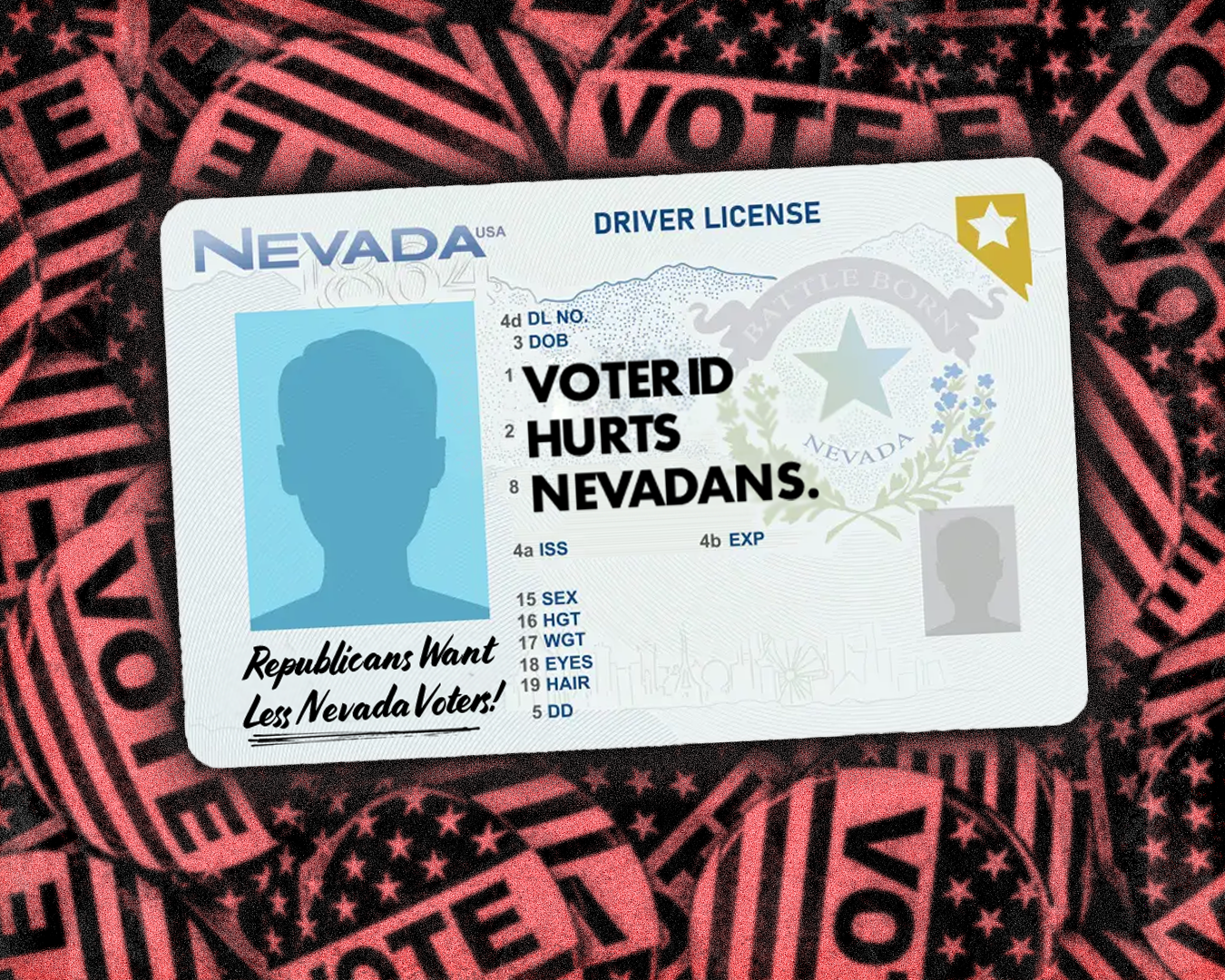
If Question 7, the Require Voter Identification Initiative, is approved, Nevada voters will be required to present valid identification during elections – a blatant attack on voters’ rights written directly into the state constitution.
Currently, the state only requires a voter’s signature to confirm identity. If the signature provided does not match their signature on file, the person must either confirm personal information related to the voter such as date of birth or provide a valid ID.
Question 7 would impose stricter requirements. In-person voters would need to present an acceptable photo ID, while mail voters would need to verify their identity using the last four digits of their driver’s license or Social Security number.
Clearly, many Nevadans feel these current laws are too lenient and threaten election integrity since the requirement passed in 2024 with 73% of the vote. Nevada requires ballot initiatives to pass twice in order to be written into the state constitution. If Question 7 passes again, Republicans will have won in creating a harsh and unnecessary obstacle to fix a problem — voter fraud — that they entirely made up.
This initiative is propelled by the myth that America’s elections are the victims of mass voter fraud. In reality, not only are Nevada’s elections already incredibly secure, but question 7 is an affront to the Voting Rights Act marginalized groups fought tirelessly for.
Low income individuals and people of color are disproportionately more likely to not possess an ID – two groups conservatives have always fought to keep from voting.
A 2024 survey conducted by the University of Maryland found that 21% of U.S. citizens with annual incomes below $30,000 face potential difficulties voting under strict photo ID laws.
The same survey found that 18% of Hispanic citizens and 14% of Black citizens face potential voting difficulties because of missing or mismatched identification. Question 7 serves as an imminent threat to the voting rights of thousands of Nevadans, as 11% of Nevadans are below the poverty line, and 31% of Nevadans are Hispanic.
Because people without qualifying identification are disproportionately low-income or members of racial minorities, voter ID laws can also disproportionately affect constituents that tend to historically lean Democratic.
While Donald Trump is famous for fanning the flames of voter fraud conspiracists, the fight for voter ID laws began years before his presidency. After the nightmarish 2000 presidential election, where Bush won by 537 votes in Florida and the election had to be decided by the Supreme Court, many Americans began to question the legitimacy of America’s strong election systems.
Since then, 35 other states have passed laws requiring citizens to present ID in order to vote.
The issue is extensive research has proven that widespread voter fraud is a complete myth. For example, in Nevada, of the 1,484,840 votes cast in the 2024 general election, 3 cases of voter fraud were prosecuted, meaning voter fraud represented 0.000002% of votes.
Election security matters, but it should not be a justification for restricting access to democracy. Nevadans should not have to overcome additional bureaucratic hurdles to exercise their constitutional right to vote.
The constitutional status of Question 7 also means that the requirement will become part of the state constitution, rather than being a statute that lawmakers can amend in the future. Reversing or appealing an amendment to the state constitution requires a two-thirds majority in both houses of the Nevada Legislature.
Enshrining voter ID requirements in the state constitution would make it harder to reverse course if these restrictions are ultimately proven unnecessary or disproportionately burdensome.
On Nov. 3, consider whether voter ID sounds reasonable only in theory, or if it’s creating unnecessary obstacles in casting votes.

