

It’s a hot, sunny day in Southern Nevada — sweat slides down your neck, and the dry air feels perpetually stuffy. Hundreds of bodies walk along the campus grounds, a crowd so dense there’s barely any room for a pedestrian to comfortably walk, and yet —
ZOOM! A scooter whizzes past, barely missing you and several other pedestrians by a mere inch.
Scooters and skateboards alike are a common sight on UNLV grounds. Everywhere you turn, you’re likely to spot one or the other zipping down the path. While scooters offer a quick way to get around campus, there come moments when driving them isn’t easy.
During passing periods — the busiest time on campus — students trying to get to class are constantly in danger of colliding with a scooter going way too fast or a skateboard weaving manically between bodies. On one thread in the UNLV subreddit, many recount their own stories of e-scooters driving too fast and nearly crashing into multiple people.
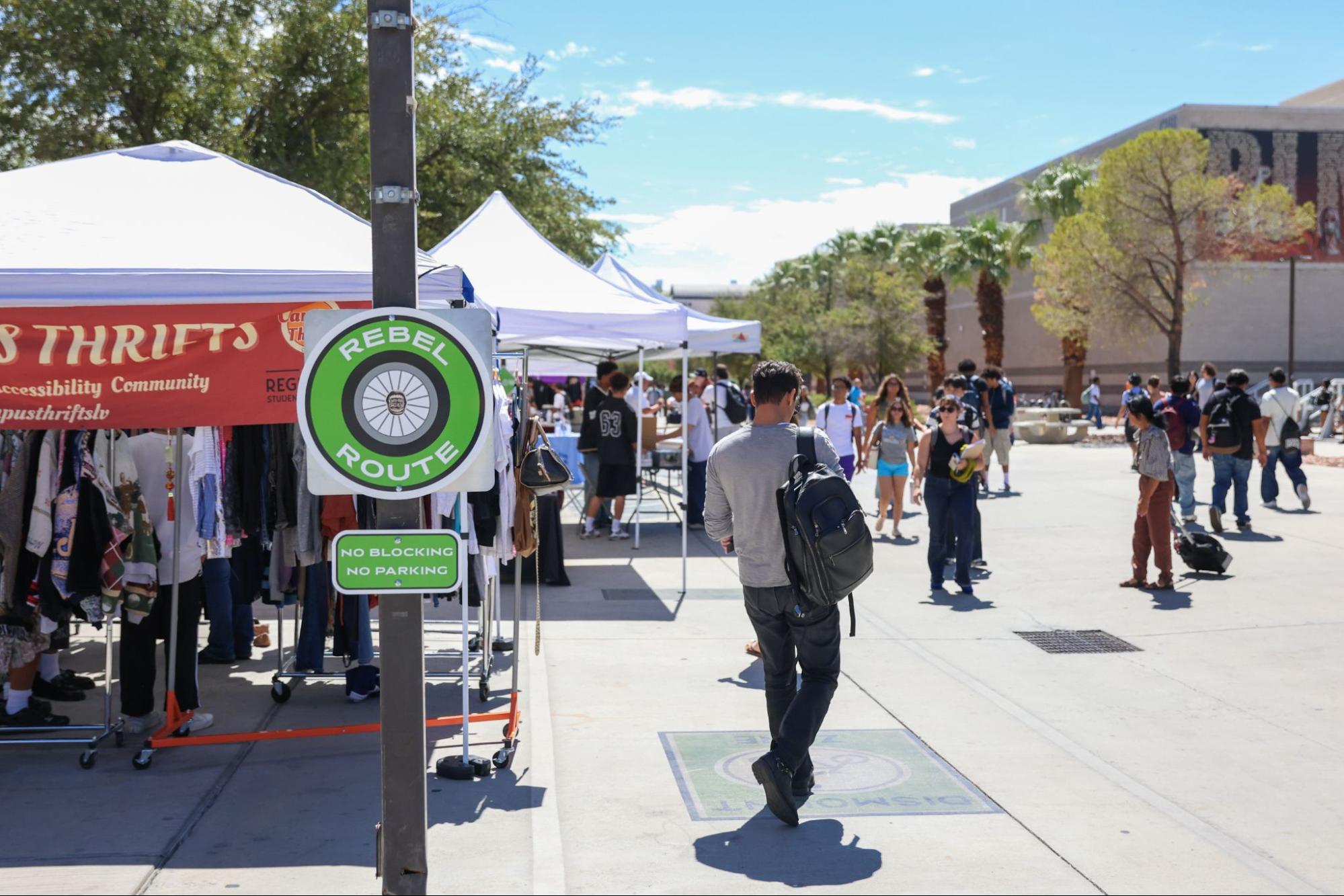
To combat this issue, senior project manager Matt Ivie and his team created the Rebel Route, an L-shaped directional signage serving as a designated lane for “wheeled conveyances” on campus, such as scooters, skateboards, bicycles and golf carts.
But what was meant to be a way for pedestrians and wheel users to peacefully coexist has accomplished essentially nothing.
As a pedestrian, it’s only natural to veer toward the right side of the road when walking. Not only is it a polite way to make room for oncoming traffic, but straying towards the right is deeply ingrained in our society through public roads and bike lanes. The only problem is that the newly incorporated Rebel Route is also stationed on the right, leading to a vast majority of students to accidentally walk all over the lanes.
There’s also the issue of club and vendor booths tabling inconveniently in these paths. Rather than placing themselves on the grass or on the other side of the road, away from Rebel Route lanes, they choose to situate on top of it. Why not move further down to the dismount zone where the lane ends? Why not move over to the other side of the road?
As for the final boss of obstacles preventing scooters and skateboards a safe and easy travel, that title belongs to the golf carts driving all over campus. These four-wheeled vehicles seem to believe that these lanes are the perfect place to park, not use, inconveniencing those actually attempting to put the lanes to use.
With various obstacles blocking the path, how are we expected to prevent accidents if we can’t even properly use the tools and solutions being provided to us?
Rebel Route is not a bad idea in itself, but when it comes down to the core of the issue — that is, creating a space separate from pedestrians — it’s not working. Some students aren’t aware that the lane exists, people aren’t following the new road rules, and we’re all still in danger of an unfortunate collision.
To combat the lack of visibility, the lanes need to be clear enough to see from far away. I suggest outlining the path with the same green color being used for the signs. For utmost usability, thermoplastic paint should be used for its longevity, and if Rebel Route wants to go a step further, it can use retroreflective materials to ensure the lanes are visible during the night as well.
As for the enforcement of these lanes, Rebel Route can benefit from additional signs clearly prohibiting non-wheeled conveyance users from using the pathways during passing periods and peak hours when the areas are densely populated with students.
Even if these problems were readily fixed, however, concerns would remain about the future of these lanes. Will Rebel Route expand to the other side of the road so it goes down both ways? Can more than one wheeled conveyance user cruise along, side by side? Do golf carts, which technically qualify as a wheeled conveyance, fit in these lanes?
Rather than just point out these problems and complain, however, we can help Rebel Route improve. By looking around and paying attention to what works and what doesn’t, you can come up with suggestions and submit them to the feedback survey.
Change may not happen the way we expect it to, but it’s a start. Innovation is all about trial and error after all — to improve, mistakes are bound to be made along the way. But unless the Rebel Route team removes the obstacles and heavily enforce the usage of these lanes, we might be better off without Rebel Route.

