

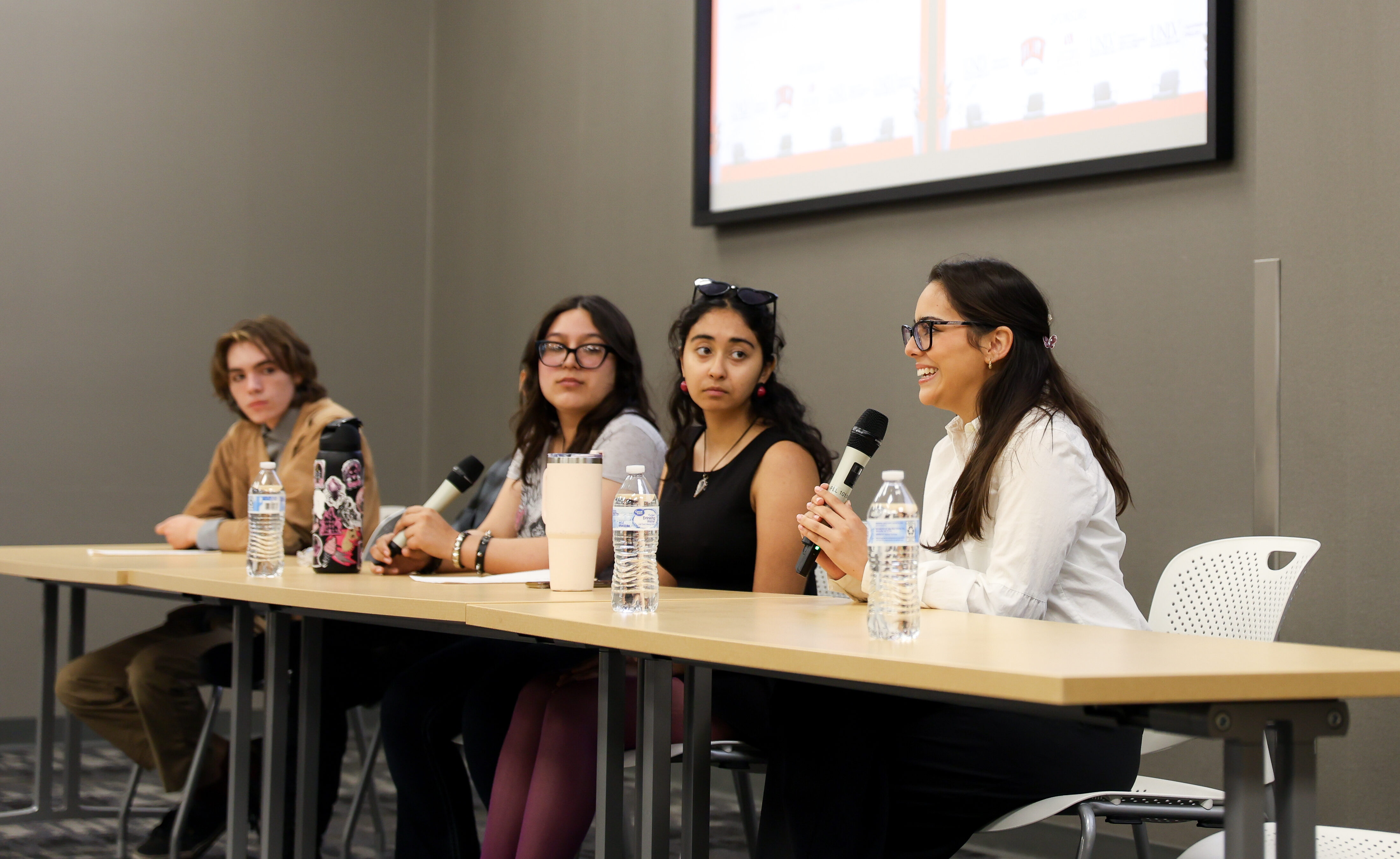
UNLV’s Interdisciplinary, Gender and Ethnic Studies Department hosted a series of faculty and student-led panels on immigration allyship and advocacy to support minority students targeted by immigration enforcement.
The “Conversations on Advocacy and Allyship” student panel on Oct. 29 included special guest Valeria Pacheco, a UNLV student who spent 35 days in Immigration and Customs Enforcement detention, whose experience inspired the conference.
It also included Feminist Club representatives Fernanda Cano, Ava Rezvannejad and Sonny Vergara, Immigration Rights Coalition representative Yvette Machado-Tuinier and Scarlet and Gray Free Press representative Ford Breathes.
Pacheco opened the mini-conference by retelling the day she was detained, her experience during detainment and what life has been like after.
She said she remembers three men in civilian clothes who approached her at the Denver International Airport and led her to an emergency exit.
“They were impatient, mean and cold,” she said. “I remember clearly how they even assumed I didn’t speak English and were making fun of me and all the people they were planning to detain, referring to us as ‘easy targets.’”
Pacheco said the women she shared the room with at the detention center became her family.
“I got to know 30 amazing women who showed me empathy from the first moment I arrived,” she said. “Even though each of us were going through very challenging times and our stories were different, they reminded me that I was not alone. I am here to open the space to talk about empathy, because I believe empathy is the reason why I am here today.”
Sandra Candel and Javon Johnson, IGES professors, and Michael Kagan, UNLV Immigration Clinic director and Boyd Law professor, spoke on the faculty panel.
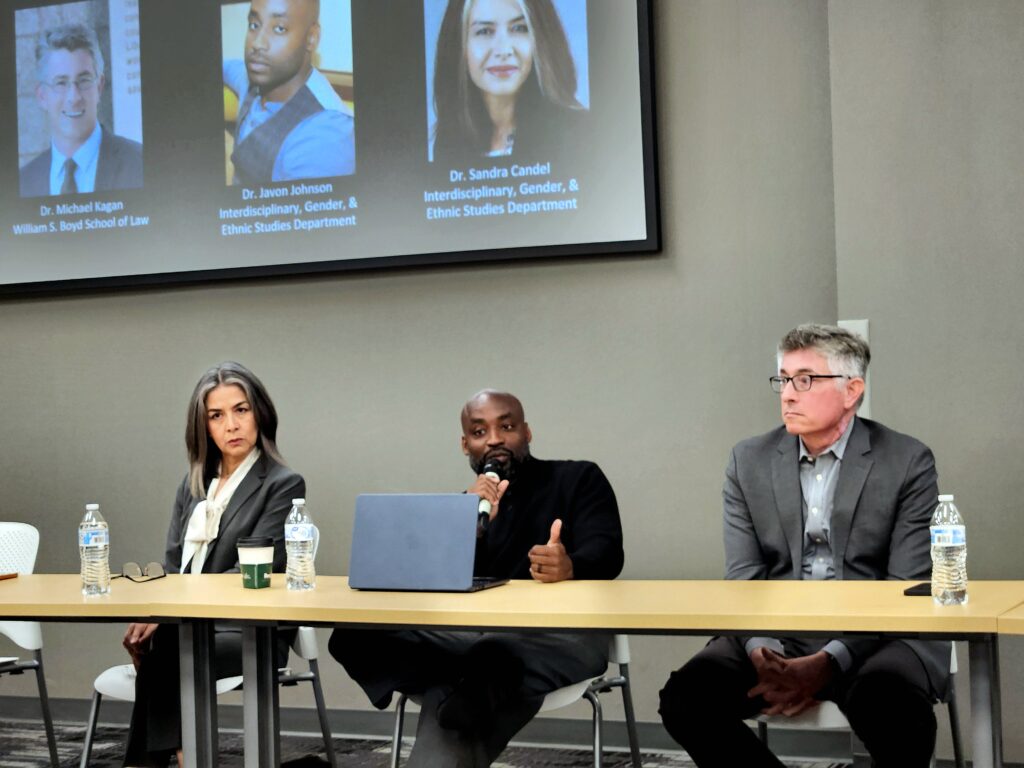
Candel said allyship means being empathetic toward oppressed groups, while advocacy means using privilege to support others without it.
“Oftentimes, we think in order for us to become allies, we have to do great things,” Candel said. “That is not the case; it’s as simple as lending an ear, being empathetic. Then advocacy, your allyship is used to amplify the voices of those who belong to marginalized communities.”
Kagan said during the faculty panel that Latino people are the most targeted in deportation campaigns.
“Our community is experiencing the third mass deportation since World War I,” Kagan said. “It is, statistically speaking, an attack on Latinos. 94% of people arrested by ICE in 2025 are Latino.”
The Cato Institute found this statistic was 90% by the end of President Donald Trump’s first six months.
The American Immigration Council found that the number of ICE detainees on any given day increased by 75% in Trump’s first year as president, reaching a record 73,000 in January 2026. Trump’s “no release” system, which limits how many individuals can seek release on bond, has led to an 87% decrease in releases, according to the report.
In September 2025, the U.S. Supreme Court ruled that immigration enforcement may detain and interrogate anyone with “reasonable suspicion,” which may include factors like location, occupation, language and race/ethnicity. Civil rights groups have argued that this legally protects profiling, leading to the disproportionate number of arrests by ICE in Latino communities.
With 71% of undergraduate students last fall identifying as a racial minority, the panels hoped to address how students, faculty and the university can be better allies and advocates.
“I feel like a lot of political discussion nowadays is very reactive and angry, and we don’t really listen to each other so much as we try to win each other over with our talking points,” Vergara said. “The best thing we can do is talk to each other and kind of reach a consensus.”
“It’s easier to look at social media and see all these issues happening nationally or internationally, but also be aware of what’s happening in Las Vegas and your neighborhood,” Breathes said. “Besides being aware or concerned about these broad issues, understand how it’s impacting your neighbors.”
Both Machado-Tuinier and Rezvannejad said the university needs to improve at protecting its students.
“I have at times felt like UNLV said, ‘We’re so proud to have the most diverse campus.’ What does that mean?” Machado-Tuinier said. “How are you putting yourselves out there to come and speak to these communities to show us not just you’re proud of us, not just that you’re proud to platform people who are safe to platform, but are you platforming issues?”
Rezvannejad discussed non-student-affiliated organizations entering campus and wanted the university to better consider student complaints about these organizations’ volunteers.
“If they would take the complaints more seriously and not allow reactionary right-wing groups to come on campus and harass students — obviously having different orgs and different political ideologies, different parties, that’s okay — but when they’re harassing students and being extremist, limiting their access to our campus would be something they could do to help.”
The panels also discussed solidarity between other marginalized communities.
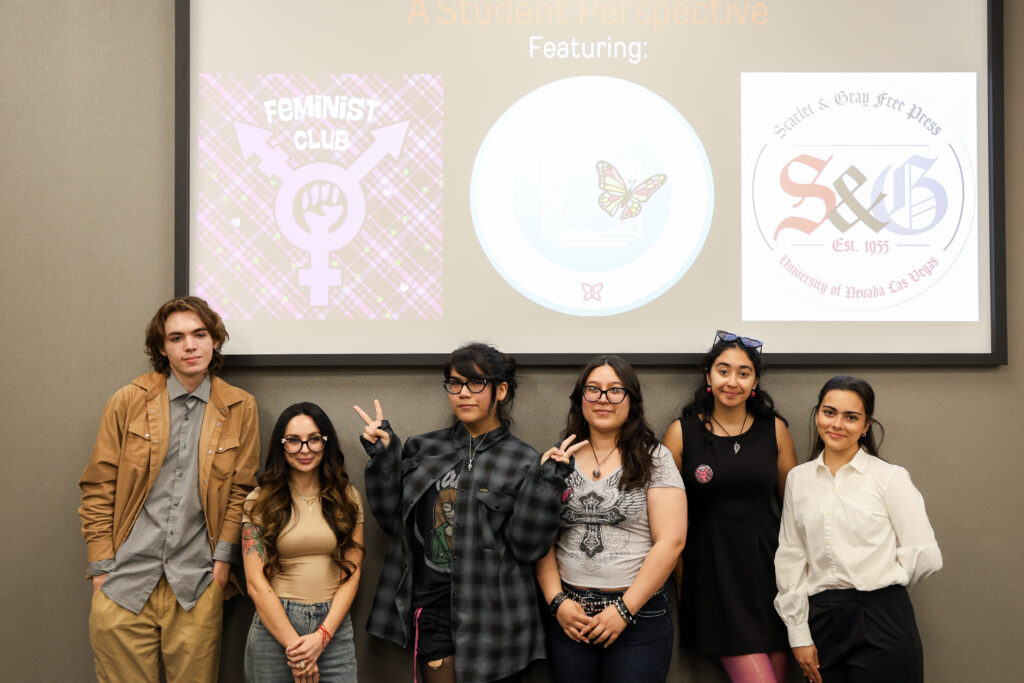
“There is no such thing as Black liberation without undocumented folks’ liberation, without women liberation, without queer and trans folk — I could keep going on, but I think you all get the point that these liberations and the path toward it are deeply interconnected,” Johnson said.
Machado-Tuinier also discussed how UNLV students should advocate for and with each other. She said they need to act as a coalition, not just a single group, when voicing concerns to administrators.
“I think a huge part of advocacy is not forgetting the community around you and how they can help you,” Cano said. “Being careful with obviously not taking over but also not being afraid of your community is one step because it can get very easy to get in your head and be prideful.”
UNLV’s Immigration Clinic offers free immigration-related legal representation and services for UNLV students and staff. Appointments can be made online.

