

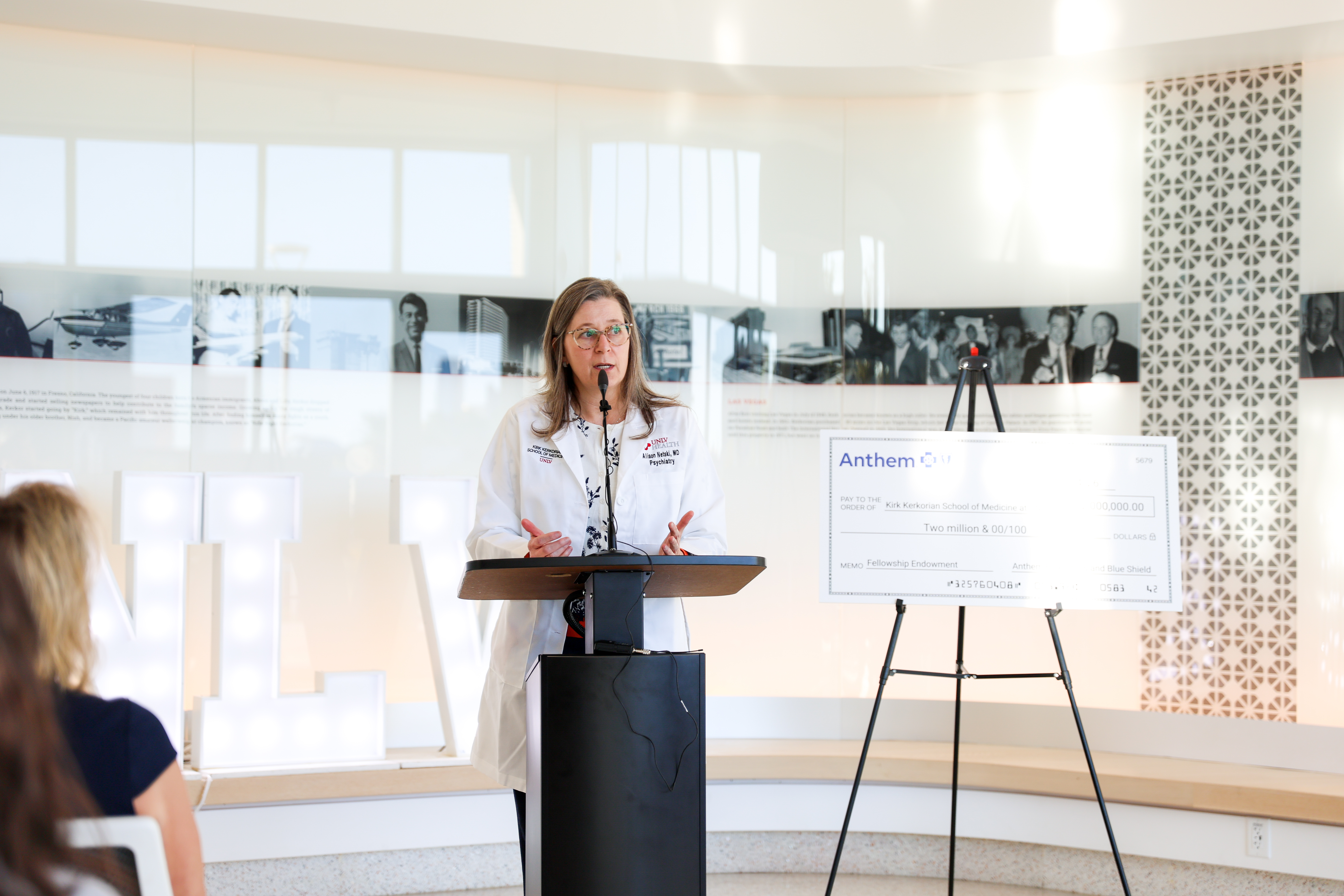
The Kirk Kerkorian School of Medicine at UNLV received a $2 million donation to expand physician training opportunities and address Southern Nevada’s physician shortage.
At a Nov. 4 news conference, Anthem Blue Cross and Blue Shield announced that the $2 million gift will establish the Anthem Fellowship Endowment, dedicated to support rheumatology training. The endowment will act as a permanent funding source to support specialty physician training and strengthen Nevada’s healthcare workforce.
During the conference, Joy Thomas, president and CEO of government business at Anthem Blue Cross and Blue Shield in Nevada, said the permanent endowment will help physicians who specialize in rheumatology and treat complex autoimmune and inflammatory conditions, such as rheumatoid arthritis and lupus. She said timely access to specialty care makes a “meaningful difference” in managing patients’ health and quality of life.
“By supporting medical training in Southern Nevada, we are ensuring that those services will be offered here,” Thomas said.
Thomas was joined by UNLV President Chris Heavey; Joann Strobbe, UNLV Health president and CEO; Dr. Alison Netski, interim dean of the medical school; and Dr. Kate Martin, senior associate dean for graduate medical education. Paul Joncich, media relations manager for the Kirk Kerkorian School of Medicine, also provided opening remarks during the news conference.
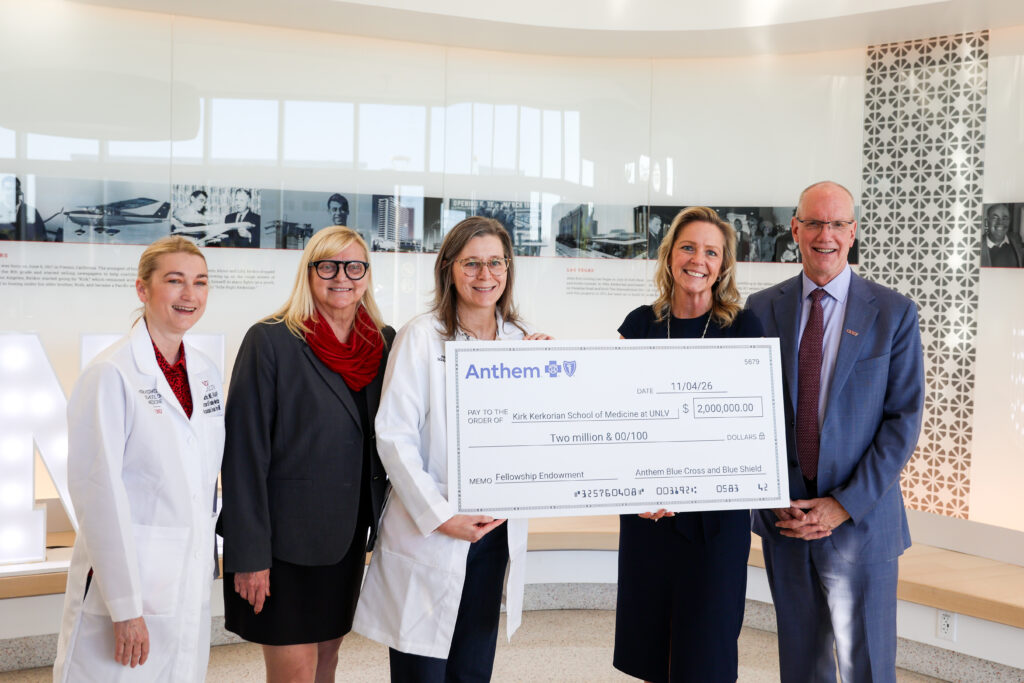
Strobbe said the $2 million will support a rheumatology fellow in perpetuity.
“In rheumatology, in Nevada, there’s only one physician rheumatologist every 125,000 people in the state. We rank 49th in the country for the number of rheumatologists per capita,” Strobbe said. “It’s critical that we invest in recruitment, but it’s easier to recruit when people actually train here in the state. So this gift is really important to have that process.”
In Nevada, rheumatologists are in short supply, with a study published in Arthritis Care & Research finding that Nevada will have 44.4% rheumatologist workforce adequacy in 2027, despite having a 97.3% adequacy demand in metropolitan areas. Under these circumstances, Joncich said rheumatologists in Nevada are “as precious as gold.”
Martin said there is no single explanation for the lack of rheumatology specialists in Nevada.
“Nevada’s shortage is part of a broader national challenge, with significant differences in where rheumatologists practice and where patients need care,” she said.
According to data released by the Guinn Research Center in 2025, nearly 65% of Nevada’s population lives in a federally designated primary medical care health professional shortage area (HPSA).
The U.S. Health Resources and Services Administration defines a HPSA as “a shortage of providers for an entire group of people within a defined geographic area” for medical, dental and mental healthcare.
The Division of Public and Behavioral Health reports that all 17 counties in Nevada face a shortage designation due to “very high ratios of population to provider.” The HRSA Data Warehouse also reflects the same data, with every county listed under its HPSA designation tool.
Martin said one gap that can be addressed is the opportunity to train here.
“Creating a program is an essential step, but retaining physicians also requires a supportive professional community and opportunities to build a fulfilling career,” Martin said. “My vision for graduate medical education is to develop both: excellent training and a place where physicians want to stay.”
Strobbe said the lack of rheumatologists in the state could be the result of bigger programs – such as Harvard, Yale and Stanford attracting them over Nevada – but that the state is now starting to gain a stronger reputation.
According to Netski, the fellowship will help retain more physicians in the state through residency.
“Creating an endowed fellowship will help us address a critical need in our community while attracting and retaining physicians. Research consistently shows that physicians are more likely to remain in the geographic area where they complete their residency or fellowship,” she said in a news release to The Scarlet & Gray Free Press. “This gift also demonstrates how a healthcare partner can step forward to help address the shortage of training opportunities that contributes to Nevada’s physician shortage.”
Martin said the goal of this investment is for fellows to see a future in Nevada and choose to stay in the state.
“I am a lifelong Nevadan. I grew up in Las Vegas and completed my education and family medicine residency in Nevada. I want more physicians to have the opportunity to build that same connection – to train here, stay here and care for the people who call Nevada home,” Martin said.
Beyond the new endowment, Strobbe said the Kirk Kerkorian School of Medicine is looking for other residencies and fellowships it can develop.
Martin estimates that the endowment will start supporting the fellowship at the beginning of the next academic year in July 2027.

