

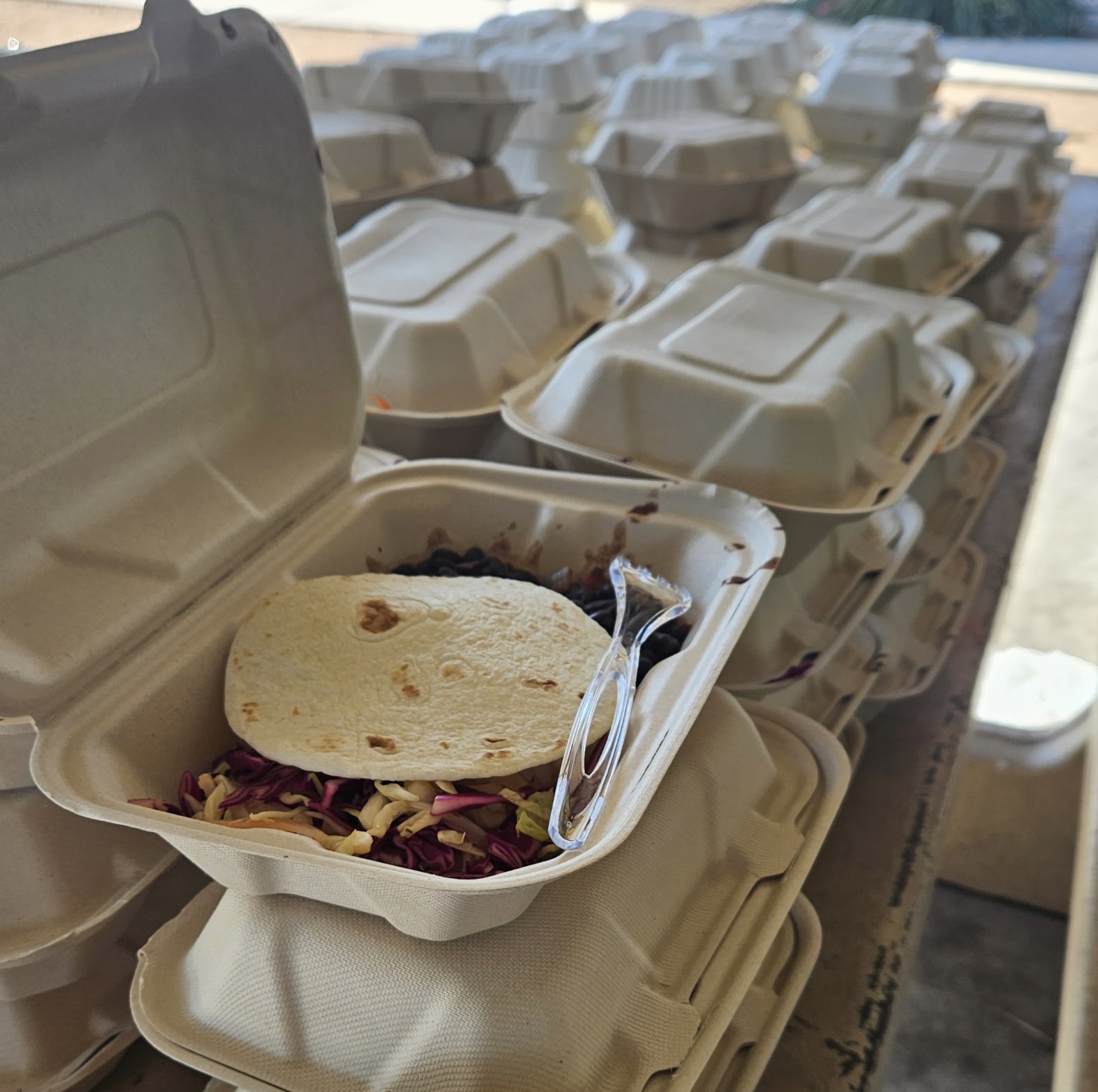
Members of the Las Vegas Liberation (LVL) gather in a volunteer’s kitchen, assisted by another local activist group called the Solidarity Fridge. The kitchen represents an environment of controlled chaos similar to that of an orchestra. Community members and activists make up the band. However, in this concert hall, the harmonics of knives slicing delicately on chopping boards while pots and pans clatter like cymbals over loud and distinct chatter serve as the instruments. Unlike an orchestra with a composer, this kitchen has no chef. No position titles – everyone here is equal.
Started in 2020, LVL identifies as a mutual aid collective and a grassroots nonprofit, aimed at building structural support systems for the unhoused and strengthening the community at large, autonomous from centralized systems. Most charities model a top-down structure, with a chain of command descending from an executive at the top. However, mutual aid collectives, like LVL, focus on one shared responsibility where everyone has equal rank. As a mutual aid organization, the emphasis lies on building community, providing what people need and not on social hierarchy.
Tyler Teresi, member of the LVL, spoke on the group’s mission: “There was a lot of motivation to make change, speak out against injustice, but also a desire to make something sustainable out of it.” He added, “Folks got together and wanted to put more effort into mutual aid and trying to lift up our communities and find ways to do that. So it kind of started with just giving basic meals out to folks in parks, folks who are unhoused, and it grew a lot more in the past couple years.”
A cry for help has led to a call for action. Acts of solidarity may not be enough however: as local policy backed by the Supreme Court stands in the way of solitude.
In the case of Grants Pass v. Johnson, the lower court’s decision was overturned despite the outcome of Martin v. Boise, which protected the unhoused from anti-camping ordinances as long as the respective city could not provide adequate sheltering for the population of unhoused people.
Lower courts sided with the plaintiffs, ruling that such enforcement was unconstitutional. The city of Grants Pass appealed, setting the stage for a Supreme Court homelessness case that would have national consequences.
In 2025, The Supreme Court determined in their 6-3 ruling of Grants Pass v. Johnson, that cities can enforce anti-camping ordinances on the unhoused, opposing the argument that those individuals should be protected under the Eighth Amendment.
If you are caught sleeping outdoors in the state of Nevada, as of 2025, you are susceptible for arrest. There is no loop hole.

“To criminalize ‘homelessness,’ as they call it, I think that is horrid to throw someone in jail instead of trying to reach out a helping hand,” she continued.
As stated by Help USA, “Las Vegas has the lowest number of affordable and available rental units for low-income renters (14 per 100) and one of the highest rates of ‘cost-burdened’ poor renters among U.S. cities.”
In Nevada, nearly 40 percent of the homeless population reported substance abuse, with nearly 45 percent of homeless in the state also having mental illness. The elements add to the misery, with 147 unsheltered individuals dying from heat-related causes in 2024.
From the group’s perspective, the disconnect between Nevada’s draconian policies and mutual aid organizations has only accelerated. However, that doesn’t stop LVL members from doing the best they can.
On Sunday, Sept. 20, unhoused Las Vegans gathered around the vehicles as LVL volunteers began handing out containers of food and cold water bottles. A man wearing fingerless gloves asked, “May I have a bag?” A woman wearing a matching workout set said, “I like your nails.” It was dark and the sun had set. A volunteer from another vehicle was passing out sandwiches. “Stay safe out here,” she said.
Moments like this occur dozens of times every Sunday – quiet, fast and full of impact. For Las Vegas Liberation, this is what mutual aid looks like: food and resources directly in hands, eye contact, no questions asked and no strings attached.
Since 2020, Las Vegas Liberation has been showing up every single week for the city’s unhoused community. Their “Their Home Too” initiative is simple in concept, but massive in impact: cook food, gather resources and distribute everything directly to the people currently living on the streets of Las Vegas. No red tape. Just people helping people. Every Sunday, volunteers take over a kitchen – someone’s home that they offered for the cause – and cook meals, assemble sandwiches and load up tupperware containers. By 6 p.m., volunteers gather in a parking lot in North Las Vegas to load up vehicles, assign groups and establish the route. From there, they drive around the city to distribute both food and water, as well as conversation, acknowledgement and care.
After loading up the food, water, utensils and miscellaneous supplies, volunteers break off into cars and head towards the areas in Las Vegas where the unhoused population is concentrated. They have a route that varies depending on where they went last week. “A big challenge we face is that people get swept pretty often,” said Teresi. “The Nevada Department of Transportation, the police, will come and if people have their tents set up on the sidewalk they’ll snatch them and tell people to leave, take their stuff, throw it away, tell people to relocate. So it makes it harder for us to find people and share with them because people are being pushed around a little bit.”
On their way to these locations, volunteers pull over if someone is spotted along the way, sometimes it’s a quick hand-off through rolled-down windows. Other times, they’ll park under a highway overpass, get out and gently wake someone sleeping on the concrete sidewalk to offer them a warm meal and cold water.
At larger stops, volunteers get out of their parked vehicles to begin distributing. They softly yell, “Food and water! We have food and water!” and gently ask those closer to the sidewalk if they would like some water or something to eat. People line up calmly as water bottles are pulled from a cooler in the back of a truck. Then a warm meal is handed out from a vented crate as the volunteer asks if they want another one. Some say yes and offer to show them the person they’re hoping to feed, but because the organization is big on “no questions asked” they are always handed a second meal. If anyone needs help carrying anything, a volunteer is there to offer bags. If there are dogs, the volunteers try to bring spare bowls and hand out water for them as well.
It’s not just about food. Some people chat with members of the LVL while they wait, others recognize the volunteers from previous Sundays. Names are exchanged, faces are familiar – it’s not a transaction, it’s a relationship.
At their final stop, a gas station with outdoor speakers playing classical music into the night, the food and water ran out but the group lingered. Instead of packing up immediately, a few volunteers spent some time chatting with someone who had come to their vehicles for food, water and connection. Fifteen minutes passed with no rush, no clipboard, no performance, before politely saying their goodbyes and heading back to the parking lot.
What Las Vegas Liberation does every Sunday is not flashy. It’s not charity and it’s not a solution to homelessness—it’s care and consistency. Every Sunday, LVL shows up–out of someone’s kitchen, in their own cars, across the city to reach members of the community. In Las Vegas, known for bright lights and luxury, hundreds go unseen – but every Sunday a neighborhood team of locals show up to say: This is their home too.

