

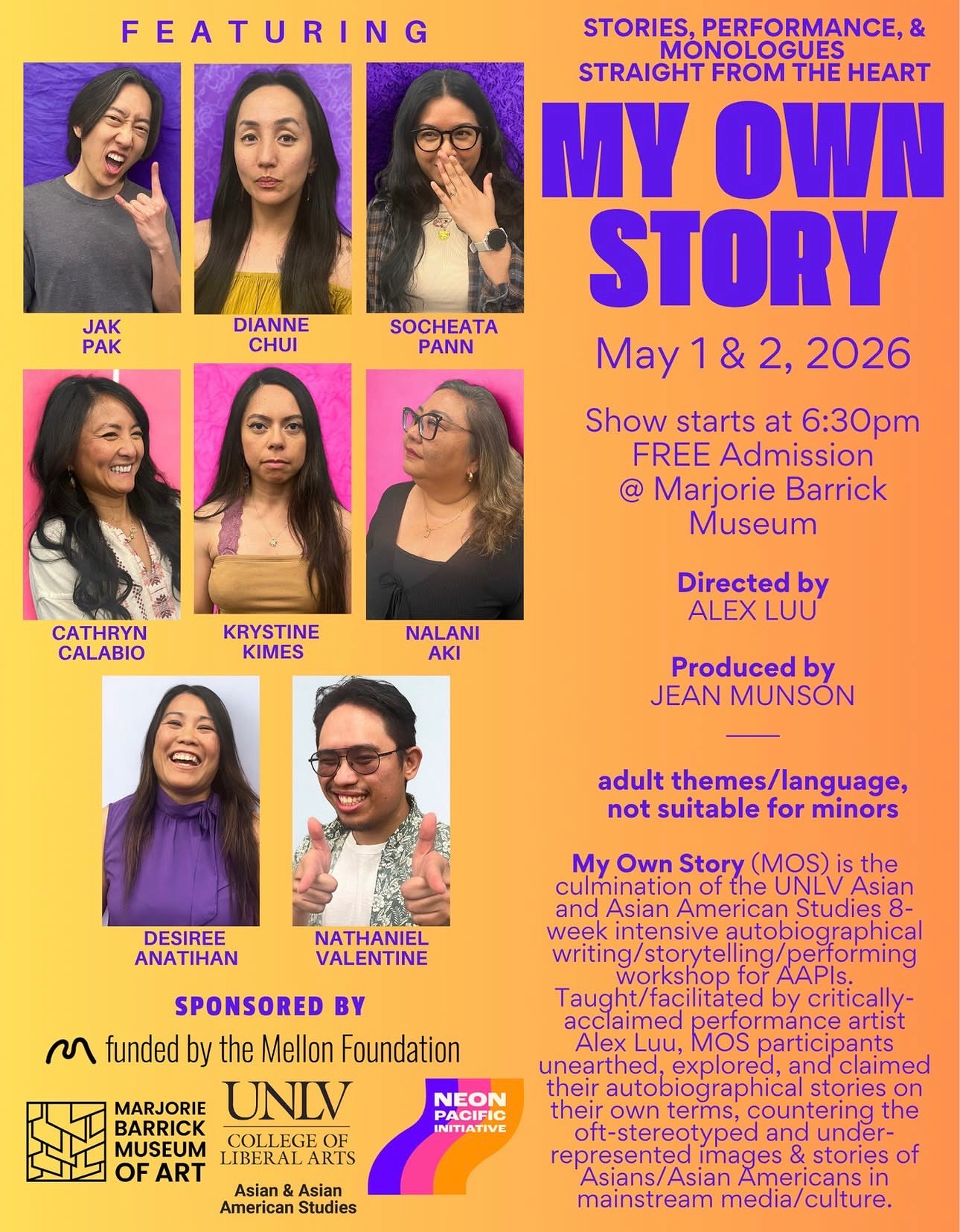
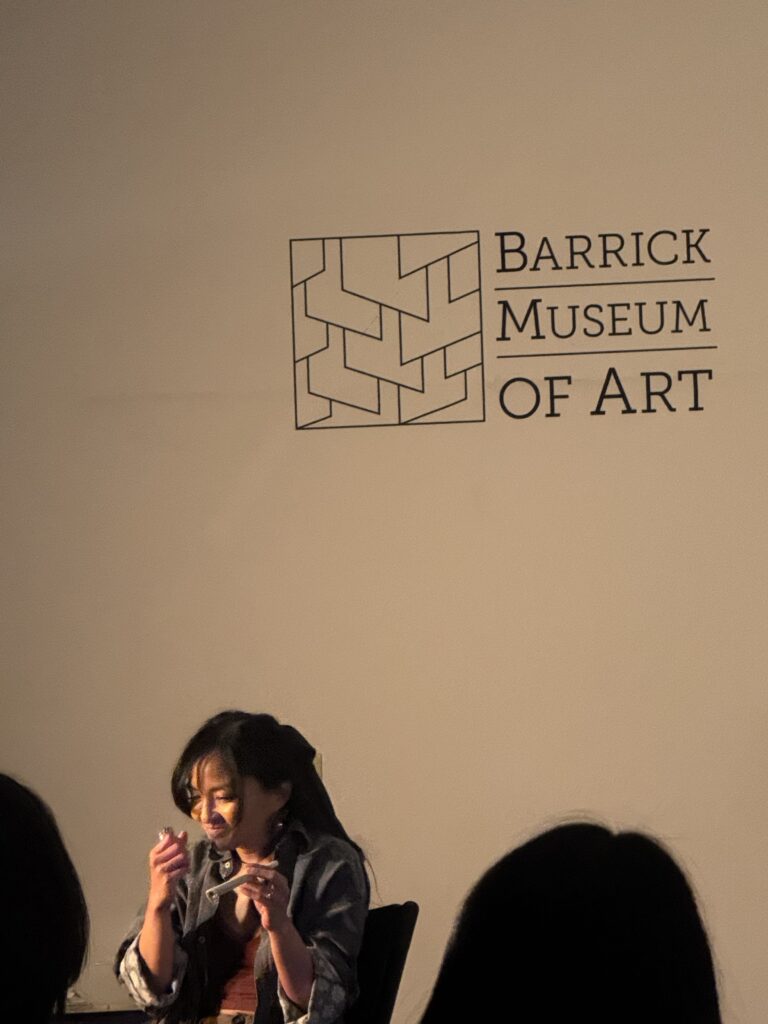
“Hey Jude” played softly from behind as Cathy Calabio stood in the Barrick Museum of Art and spoke to her late father.
“You still live in my bones and in my blood,” she said aloud to a live audience. “I see you in my hairline, my height, my moments of courage and determination.”
Her monologue was titled, “Ode to Deo,” an elegy to a man whose Latin name means “thanks be to God” and whose memory she shared in her performance for “My Own Story (MOS),” an eight-week storytelling workshop highlighting Asian American and Pacific Islander (AAPI) experiences.
“And I thank God, or whoever’s out there, that I was born your daughter, Papa,” Calabio said. Though a full audience was in front of her, she spoke as one does through prayer.
“I love you, forever and ever, until the end of time,” she finished.
Calabio’s monologue was one of seven deeply vulnerable stories shared during the two final performances of MOS on May 1-2.
UNLV students, alumni and Las Vegas community members took turns returning to moments in their lives as stories that they had discovered, or rediscovered.
Performers included Jak Pak, Dianne Chui, Socheata Pann, Cathryn Calabio, Krystine Kimes, Desiree Anatihan and Nathaniel Valentine. Nalani Aki, one of the eight in the workshop, was unable to attend the performances due to illness.
Director Alex Luu, performance artist and founder of MOS, co-produced each monologue, taking the performer’s words directly from their writing prompt entries they completed during the workshop. Stories that began as uncensored thoughts jotted in notebooks transformed into autobiographical, spoken word pieces.
The performers explored themes of family, mental health, ancestry, relationships, grief, pain and all the emotions in between. This year, the performers chose a name for their crew – LV8, for the eight Las Vegas participants.
But the eight weeks of MOS were more than just writing samples and movement exercises or routines and memory sharing: They were a chance to process their experiences, and, especially, to heal from them.
“The feelings that we feel in our stories are real. They’re ours,” Calabio said. She explained that she was nervous to express her feelings to her father during her monologue but was reminded by Luu that her expression was meant to be a celebration.
“It’s something that I feel like I’ve processed (her father’s passing), but the more that I work on it, the more I realize the pain still lives there,” she said. “It doesn’t really go away. It just gets better with time.”
Performer Nathaniel Valentine’s monologue, “Kanlugan,” meaning “sanctuary” in Tagalog, explored his experience grappling with what he called the “colonial mentality,” an expectation that greatly affected him throughout his teenage years after immigrating to the United States at 12 years old.
“Road Trip,” a monologue by performer Krystine Kimes, shared her time in a mental health facility, causing her to return to college a year late and miss graduating with her class.
“I lost everything,” Kimes said to the room. Her friends, her boyfriend – everything, she said.
She spoke of aimlessness, suicide and desperation, detailing the moment she decided to drop everything and drive from Las Vegas to South Carolina on an impulse.
Every word meant something. Every word mattered.
MOS was funded for the last three years as part of the Neon Pacific Initiative, an $800,000 funding project supported by the Mellon Foundation to grow the UNLV Asian American Studies program.
“The goal of the grant is to help us tell and understand more complete and accurate stories of Asian Americans but also more complete and accurate stories of Las Vegas,” said Mark Padoongpatt, UNLV associate professor and director of Asian and American studies, as well as grant overseer. “And ‘My Own Story’ I think reflects that beautifully.”
“Asian Americans are allowed to take up space,” Valentine said. “Whether it be within society, within the government, in public places. We are here.”
This is the last year that the grant will fund MOS, leaving the future of the workshop unclear. Luu is unsure whether he will be able to secure another funding source in order to continue the workshop next year, but is optimistic that this will not be the absolute end for the program and its performers.
Performers like Calabio and Valentine may not experience a cathartic opportunity like this again.
“It boggles my mind that you’ve been gone for so long. Nine years,” Calabio said. “I miss you every single day.”
She spoke to him, to the air, to an audience or maybe to herself.
“And now I do have a house, and I do have a room for you to sleep in,” Calabio said to her father. No one moved; no one said a word. “It’s got a small, twin-size bed, but you can stay with me anytime.”

