

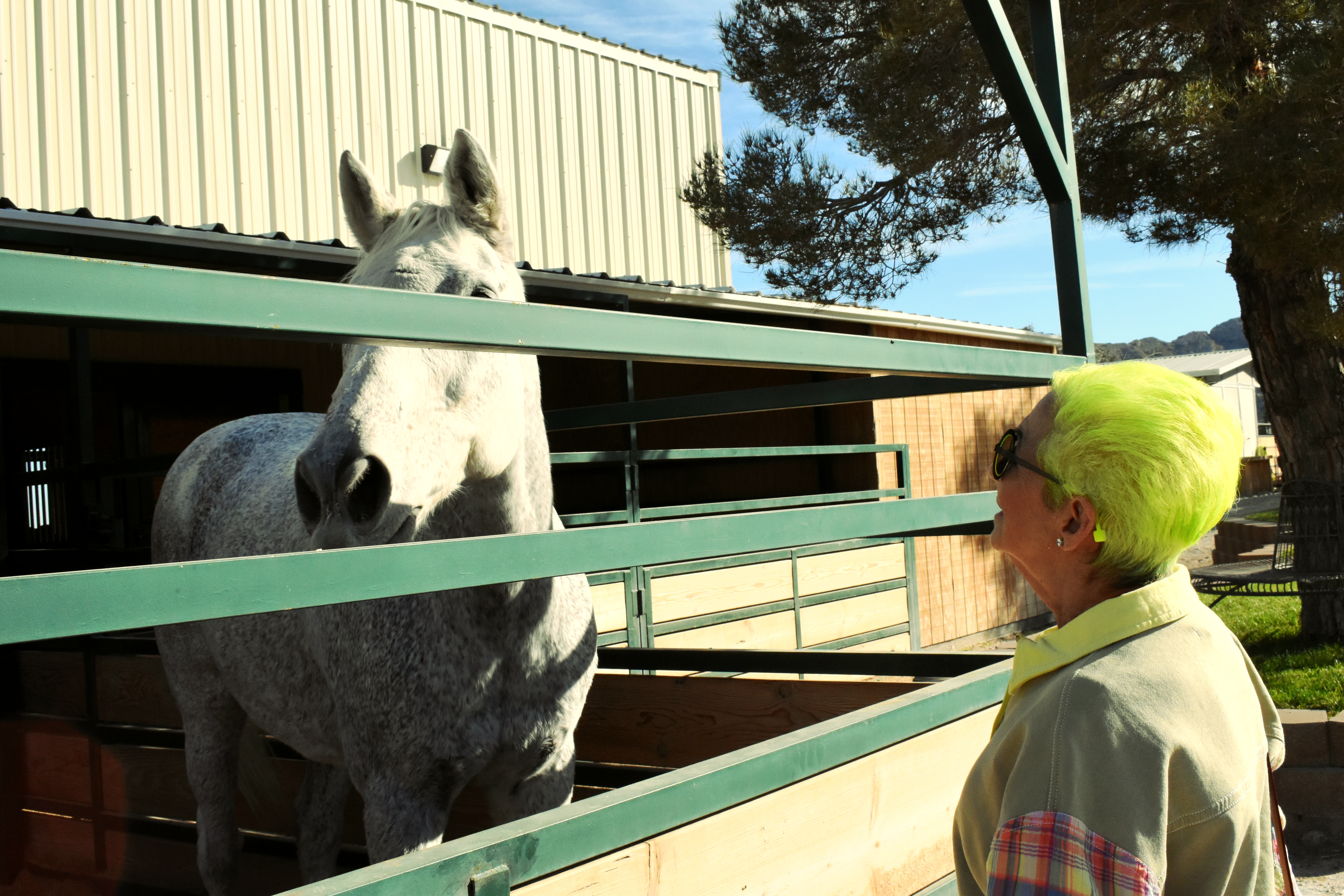
On the way to Mount Charleston lies 18 acres of land where rescued horses await new homes or spend their remaining years.
For The Love of Horses is a nonprofit rescue organization founded by former UNLV communications professor Alice Whitfield-Hammer that seeks to help horses who have been abandoned, abused or surrendered. It aims to provide a safe temporary or permanent home for horses in need.
She said the hardest part is getting visitors and volunteers because the rescue is out farther than many people are willing to drive.
“The frustration comes when you know how good you are, when you know that you’re honest, when you know that you have everything that it takes to make it work,” she said.
Whitfield-Hammer founded the rescue with her husband as a division of Hearts Alive Village called Hearts Alive Village Horse Rescue in 2021 after retiring.
“We were newlyweds at the time. He was my junior high school boyfriend, and we reconnected after 60 years,” Whitfield-Hammer said. “He said, ‘What’s on your bucket list?’ and I said, ‘Anything with horses’ and that’s how it started.”
A study by the American Society for the Prevention of Cruelty to Animals found there are 200,000 unwanted horses in the United States. It also stated that 6,000 to 10,000 horses are in rescues at any given time.
For The Love of Horses seeks to rehome most of its horses but will keep permanent residents who need specialized care because of an incurable injury or fixed behavior. Sharon McGarry, ranch manager, said the rescue sometimes will cover food and medical costs so owners can keep their horses during financial hardship.
The organization received its first horse in August 2021. It has since grown to 48 horses and now operates at maximum capacity.
McGarry said the rescue only goes over capacity in temporary emergencies. It also has agreements with three locations to care for up to four horses when space is needed.
She said Desert Pines Equine visits weekly and has a strong relationship with the rescue. The rescue is building relations with Clark County Animal Control and Pahrump Animal Control, from which it has previously received horses. It is also currently fostering a horse for Mount Charleston Forestry.
The U.S. Bureau of Land Management estimated in March that there were 749 wild horses and 1,048 wild burros across 60 miles to the west and northwest of Las Vegas.
Whitfield-Hammer said that many local horse owners often drive out of state if their horses need long-term rehabilitation. The rescue’s current goal is to create a five-acre horse rehabilitation center, the first in Las Vegas.
“We’re trying to show people that there’s nothing like us and when they finally do come up, they’re blown away,” Whitfield-Hammer said.
The expansion would also allow for 15 additional horses.
For The Love of Horses uses Facebook and Instagram for digital marketing. Whitfield-Hammer, a former Broadway performer, has organized two shows to help promote and fund the rescue’s operations.
With limited funding to hire a larger staff, For The Love of Horses relies on volunteers.
Volunteers clean stalls, change water and can choose a horse to interact with individually.
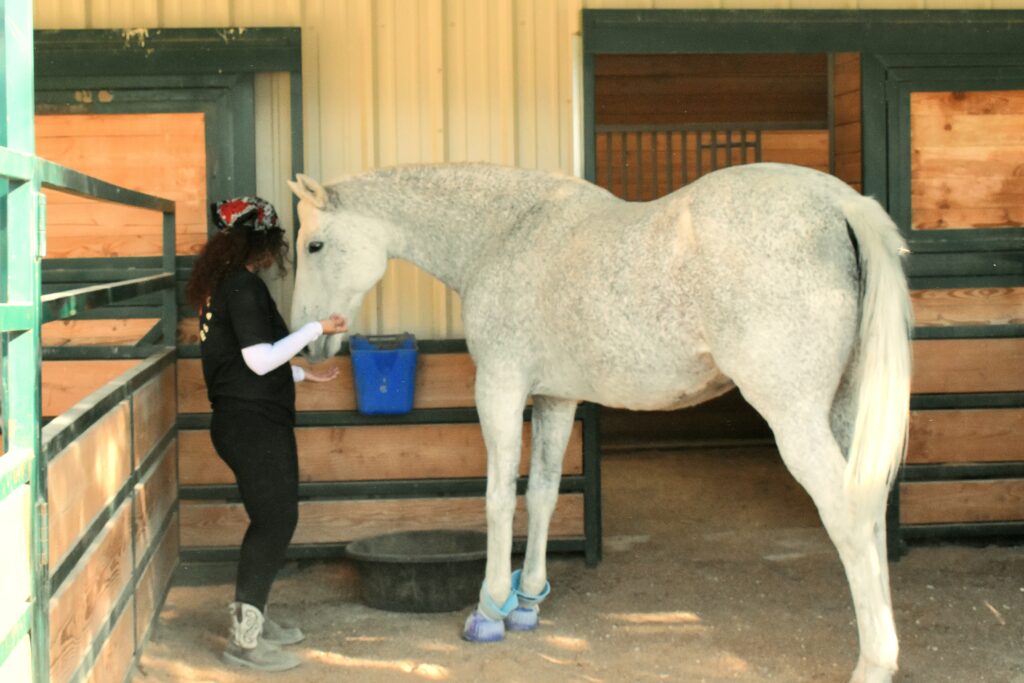
Ivet Aldaba, a UNLV social work professor who began volunteering with the rescue last December, was fascinated by how involved the staff is and rearranged her schedule to volunteer.
“It’s such a profound experience to witness a transformation of these horses as they gradually regain their strength, their confidence and then trust in humans,” Aldaba said. “I think it’s something that you really have to see with your own two eyes to be able to understand how powerful that is.”
Aldaba said that people should keep an open mind and try volunteering with the rescue, regardless of their interest in horses. She also said volunteers can stop their task at any time if they are uncomfortable and are encouraged to ask as many questions as possible.
“It’s a rewarding experience, and it’s an experience that doesn’t exist anywhere else,” she said. “I think it gives people a renewed sense of hope, quiet empathy, awareness, but also peace.”

